Pages

Thursday, September 8, 2022

Ferruginous Pygmy Owl: Bird Identification, Habits, Facts, Nesting

The Ferruginous Pygmy Owl is an owl very prevalent in the United States, all of North America, and parts of Central America. It can be found along Mexico’s southern Arizona and West Coast. It’s also easy to find them in the southern Texas area and in South Mexico going all the way to Panama.

Other names for the Ferruginous Pygmy Owl include the Cactus Pygmy Owl, the Streaked Pygmy Owl, the Gnome Owl, and the Ferruginous Owl.

Besides the significant facts about these majestic creatures shared above, there are other interesting and fun facts that we’d like to teach you today. In fact, I have a plethora of different topics that I’d like to share. They include:

  • Ferruginous Pygmy Owl identifying characteristics
  • Interesting and fun facts about Ferruginous Pygmy Owls
  • Characteristic differences between female and male ferruginous pygmy owls
  • Nesting behaviors, migratory habits, dietary preferences, and feeding habits
  • Additional facts about ferruginous pygmy owls

To discover more about these beautiful diminutive creatures, please continue reading below.

Ferruginous Pygmy Owl Bird Facts

  • Common Name: Ferruginous Pygmy Owl
  • Scientific Name: Glaucidium brasilianum
  • Scientific Family: Strigidae
  • Life Span: 6-7 years
  • Size: 5.9 to 6.0 inches
  • Wingspan: 14.5 to 16.0 inches
  • Weight: 2.2 to 2.7 oz
  • Conservation status: Least Concern

How To Identify A Ferruginous Pygmy Owl

First off, the ferruginous pygmy owl is very small. One distinguishing characteristic is that it doesn’t have any ear tufts. The lores and eyebrows of this beautiful creature are white, and although this bird has other white markings, these white markings are very distinguishable.

Its chest has white feathers covered with rufous-brown streaks. And its eyes are black with white yellow irises. It has a yellow bill that can also be greenish, grayish, and grayish-yellowish depending on the particular bird.

Differences Between Male & Female

There aren’t any major differences between male and female plumage of the ferruginous owl. The only major difference is in size, and it has nothing to do with plumage itself. The female owl is bigger than her male counterpart.

Differences In Summer Plumage vs Winter Plumage

There aren’t any differences in the local feel of plumage during summer, winter, spring, or fall months for the ferruginous pygmy owl.

Ferruginous Pygmy Owl

Where You’ll See Ferruginous Pygmy Owls

The ferruginous pygmy owl likes to spend its time in habitats that include saguaros, desert riverine words, and Mesquite thickets. In southern Texas, you’ll find it in plentiful supply and low stands of live Mesquite and oak.

Ferruginous Pygmy Owl Migration Patterns

This nocturnal bird lives and breeds in southern Texas and South-Central Arizona throughout the US. It’s also around in plentiful proportions on the map in Mexico in the self and parts of Central America including Argentina, Bolivia, and Paraguay.

Diet and Feeding Preferences

The ferruginous pygmy owl is a carnivore that feeds on a wide variety of creatures including mammals, reptiles, birds, and insects. In particular, when feeding on insects, it usually sticks to smaller insects including caterpillars, crickets, and grasshoppers. But it is known to eat large insects and scorpions as well.

But that’s not all, because it will eat reptiles too. In fact, it is known to hunt and eat small lizards and it will even eat these creatures whole. Examples of small lizards that will eat whole include the Great Plains skink and the four-lined skink.

As far as mammals are concerned, the species that it hunts the most our various rodents including mice, rats, deer mice, and more. It’s also known for eating shrews as a fairly large part of its diet as well.

Ferruginous Pygmy Owl Nesting Facts

  • Clutch Size: 2-7 eggs
  • # of Broods: 1 brood
  • Incubation Period: 24-27 days
  • Nestling period: 26-35 days
  • Egg Description: White

The great thing about ferruginous pygmy owls is that these creatures are monogamous and they find a partner and form a lasting lifelong bond with them. Their breeding season takes place during late winter and goes into early spring. During the nesting period, the pair will nest within tree holes or a cavity within the cactus often left behind by woodpeckers.

After the meeting, the female will have anywhere from 2-7 eggs and she will incubate these eggs for 24-27 days. During the incubation period, the male will bring the female food and continue to do so until the first few weeks of hatching have passed. The owlets fledge after reaching roughly 30 days old. At this point, they become independent creatures and move away from their parents roughly 3 weeks afterward.

Ferruginous Pygmy Owl Behavior

The ferruginous pygmy owl is considered a crepuscular creature, but it still hunts by day quite often. From its perch, the small owl will recognize its prey and fly very quickly and rapidly toward the animal that it is hunting. During this quick flight, he will grab its prey using its talons and it will capture the creature to bring it back to its nest to feed its loved ones.

At night, ferruginous pygmy owls are known to become vocal. They are also very vocal during the period of sunrise and sunset. Mainly, it gives a whistling call that sounds like hoo-hoo-hoo-hoo.

They enjoy spending their time by themselves, but they also tend to remain in pairs during mating season. They have an interesting way of moving in trees. Instead of flying from branch to branch, they like to walk and hop from one branch to another. But they also move using short flights that take them directly to the location of their choosing.

While flying, they look very similar to many woodpeckers. Their flight consists of undulating in motion. When things appear dangerous or exciting, the ferruginous pygmy owl Wilcock hits its tail and moves it back and forth from side to side.

Conservation Status

The conservation status of the ferruginous pygmy owl is considered Least Concern. This means that at the moment the owl species isn’t considered endangered. Although, it’s important to note that the population of this owl is quickly dwindling. 

And in some areas of the United States, they are threatened or endangered, which means they are well on their way to becoming an endangered species if conservationists can’t save them from their biggest threat, which is habitat loss. One of the biggest reasons why they are losing their habitat is due to grass fires, which catch very easily and spread throughout their main habitat.

Fun & Interesting Facts

  • This species is also a member of a much larger family. They are also a member of the typical owl family. It contains the wide majority of owl species.
  • The ferruginous pygmy owl contains a patch of darkened feathers on the back of its head. These feathers actually look like eyes. Many people call them false eyes because they can fool prey while they are hunting.
  • The ferruginous pygmy owl, just like all owls, actually has three different islands. They have an eyelid for blinking, an eyelid for sleeping, and a third eyelid that makes it easy to keep their eyes clean.
  • Ferruginous pygmy owls are often mobbed by smaller birds. Even though this species is very small, the other birds never have difficulty locating them. As many as 40 birds that makeup 11 different species will mob the ferruginous owl.
  • The ferruginous owl is small and stocky, and its feet and talons are disproportionately large. It has an elongated crown, white and buff streaks, and its wings are covered in white spots. The undercarriage of the ferruginous owl is also street heavy with white streaks.
  • A study that took place on the King Ranch in Texas discovered that the ferruginous pygmy owl will prey on other birds including the eastern Meadowlark, blue grosbeak, Northern cardinal, and other varying songbirds.
  • A subspecies of the ferruginous pygmy owl known as the cactus ferruginous pygmy owl has substantially declined in population throughout Arizona. It was even considered an endangered species between 1997-2006. But it is no longer on the endangered species list.
  • The population of the ferruginous pygmy owl in Sonora, Mexico dropped dramatically by 36% between 2000-2009. So, the population is definitely declining, although it isn’t considered an endangered species at this time.
  • It’s easiest to see ferruginous pygmy owls in the United States in South Texas. They are known for spending time on bird-friendly ranches in the area. Many of the Rio Grande floods in July 2010 forced this species out of its traditional haunts near the border of Mexico.
Ferruginous Pygmy Owl sitting on a pole

Explore More Species in This Family


from BirdInformer.com https://ift.tt/ikQFrG4

Northern Saw-Whet Owl: Bird Identification, Habits, Facts, Nesting

The Northern Saw-Whet Owl is a bird species with a number of other common names. Their names include White-Fronted Owl, Saw-Filer, Queen Charlotte Owl, Whetsaw, Sparrow Owl, and Kirkland’s Owl.

What’s the reason behind the name? Well, these beautiful creatures with yellow eyes and a large round head also sound like a saw that happens to be getting sharpened on a whetstone. Others believe the sounds made by the Northern saw-whet owl sound like sore teeth being sharpened.

Nevertheless, I’d like to share as much information as I possibly can with you today about the Northern saw-whet owl. I have a wide array of topics that I’d like to cover. The most critical areas include:

  • The characteristics needed to identify the northern saw-whet owl
  • Fun facts about the northern saw-whet owl
  • Male and female Northern saw-whet owl differences, if any
  • Feeding habits, dietary preferences, nesting behaviors, and migratory habits
  • Other facts and information about the northern saw-whet owl

To learn more about this beautiful nocturnal creature, please continue below.

Northern Saw-Whet Owl Bird Facts

  • Common Name: Northern Saw-Whet Owl
  • Scientific Name: Aegolius acadicus
  • Scientific Family: Strigidae
  • Life Span: 7-16 years
  • Size: 6.7 to 8.7 inches
  • Wingspan: 16.5 to 22.2 inches
  • Weight: 1.9 to 5.3 oz
  • Conservation status: Least Concern

How To Identify A Northern Saw-Whet Owl

The northern saw-whet owl is typically made of a mottled brown color and it has a facial disk with white feathers. Their head is mostly brown but it also has white spots contained within. The adult Northern saw-whet owl also has yellow eyes. Juveniles, on the other hand, have a creamy yellow belly and breast and dark brown feathers.

Differences Between Male & Female

As far as plumage is concerned, there aren’t any differences between females and males. The size differences between male and female Northern saw-whet owls are an entirely different story. In fact, the female version of this bird species is roughly 25% heavier than her male counterparts.

Differences In Summer Plumage vs Winter Plumage

There are no major differences in plumage colors during summer, winter, fall, or spring. Their plumage remains the same color all year-round.

northern saw-whet owl

Where You’ll See Northern Saw-Whet Owls

The northern saw-whet owl is a bird that prefers living in the forest. You’ll find them all throughout northern North America because they use the extensive forests in this area for their breeding grounds. 

On occasion, you will find them in open habitats as well, with an example being the shrubsteppe of the West. In the winter, they’ll be found in the southern and central United States in dense forests.

Northern Saw-Whet Owl Migration Patterns

During the winter, many of the northern saw-whet owls prefer to migrate to the lower elevations or they’ll migrate directly down south. Other Northern saw-whet owls tend to remain in the same place all year round.

They also irrupt once every four years. During this time, a great many Northern saw-whet owls in much larger numbers will head south. The migration will take place at night and the owls will use several different migratory routes across North America. This owl has the ability to cross large water expenses as well.

Diet and Feeding Preferences

The diet of the northern saw-whet owl is relatively straightforward and very similar to the majority of other owls. Since this beautiful bird lives in the forest, it is particularly partial to small rodents and other forest-dwelling creatures. For the most part, they tend to eat large birds and insects on occasion, and regularly eat young squirrels, mice, voles, and shrews.

Northern Saw-Whet Owl Nesting Facts

  • Clutch Size: 4-7 eggs
  • # of Broods: 1-2 broods
  • Incubation Period: 26-29 days
  • Nestling period: 27-34 days
  • Egg Description: Smooth white

The female Northern saw-whet owl is the one that will likely choose the nesting site. Males do participate in this activity on occasion, and they will perch in a potential area for a future nesting site while giving off their call.

For the most part, their nests are typically taken from previously excavated holes left behind by pileated woodpeckers or Northern Flickers. They’re willing to use nesting boxes as well.

During nesting, the female will lay eggs and keep them at the bottom of the cavity in debris made of mammal bones, hair, grass, moss, twigs, and wood chips. The whole is usually 8-44 feet off the ground, and it tends to measure 19-18 inches deep and 3 inches wide. The entrance hall is usually only 2-3 inches across.

Northern Saw-Whet Owl Behavior

The Northern saw-whet owl is a nocturnal creature. It starts its day at late dusk when it begins its daily activities.

This isn’t a problem for this owl because it has a phenomenal low-light vision. It can use its excellent night vision to find prey in the dark. Even though the owl will catch its prey in the middle of the night, it often keeps it safe and secure and then carries its prey to the place where it roosts during the daytime. It will stand on the prey until the next evening and then eat it.

If the northern saw-whet owl is ever discovered, it will completely sit still and avoid flying until the threat passes. Because of this behavior, many people consider this owl to be tame.

Tips for Birdwatchers On How To Attract Northern Saw-Whet Owls

The northern saw-whet owl is actually the smallest owl in all of North America. These little owls are actually quite ferocious and vicious predators of small rodents and mice. If you’re looking to keep your mice population under control, attracting these owls to your backyard is a good idea.

Some tips to do so are as follows:

  • Think about putting a nesting box in your backyard. Put it relatively high up in a tree anywhere from 20 to 40 feet. They do not mind nesting in man-made boxes. Put up before late winter, which will increase your chances of attracting a Northern saw-whet owl tremendously.
  • Another trick is to add a brush pile to your backyard. This is something that the northern saw-whet owl will find very attractive. You could also leave sticks and twigs scattered around your yard for the same purpose.
  • Put a bird feeder in your backyard. The owl will not likely eat from it, but you can also add bird seeds to the ground below the feeder. These tiny predators will definitely find these seeds quite interesting and appealing.
  • Adding a birdbath to your backyard is always a good idea as well. These smaller predators like having a fresh source of available water ready and on hand. The birdbath will give them a place to readily drink from and clean themselves whenever some refreshment is needed.

Conservation Status

The conservation status of the northern saw-whet owl is considered Least Concern. While the number of saw-whet owls in North America has likely declined, there hasn’t been any significant population loss to consider this an endangered or threatened species.

northern saw-whet owl perched on tree branch ready to fly

Fun & Interesting Facts

  • The colors of the plumage of adult and juvenile Northern saw-whet owls are very different. It’s so different that they even seem like two different owl species. By one year of age, the juvenile Northern saw-whet owl will molt for the first time. It will get its full adult plumage at this point and also reach sexual maturity.
  • The male saw-whet owl handles all of the hunting and the female takes care of the incubation and brooding. When young owls reach 18 days old, the mother will leave the nest and begin to roost in a different location. She often avoids returning to the nest altogether, even avoiding helping her nestlings. Males, on the other hand, continue feeding the young nestlings even after the female is no longer in the nest. This will last for about a month once the young Northern saw-whet owls have fledged.
  • During the active nesting period, the female saw-whet owl does a great job of taking care of the nest and she will keep it extremely clean. Once the area is abandoned by the female, and the male takes over completely to continue with feeding, the nest begins to accumulate a mess. By the time the nestlings leave the nest entirely, there is a layer of pellets, feces, and prey parts remaining in the nest.
  • Since humans can approach Northern saw-whet owls, many look at them as team creatures. In fact, when it is roosting on a branch, they often allow human beings to pick them up, which seems hard to believe. More than likely, this is happening because the owl has never come into contact with human beings before in the dense forest habitat. So, they have no idea whether or not human beings are dangerous.
  • These owls are known to keep extra food cash available. At one time, they could potentially kill as many as six mice. They will kill them and not even consume them during their hunt. They may even have cached prey that ends up freezing during the winter. When they retrieve the cached prey, the saw-whet owl will carry it with them to the roosting area and allow the prey to thaw out. It thaws out when the saw-whet owl lays on it, similar to incubating eggs.

Explore More Species in This Family


from BirdInformer.com https://ift.tt/PCOlKG0

Wednesday, September 7, 2022

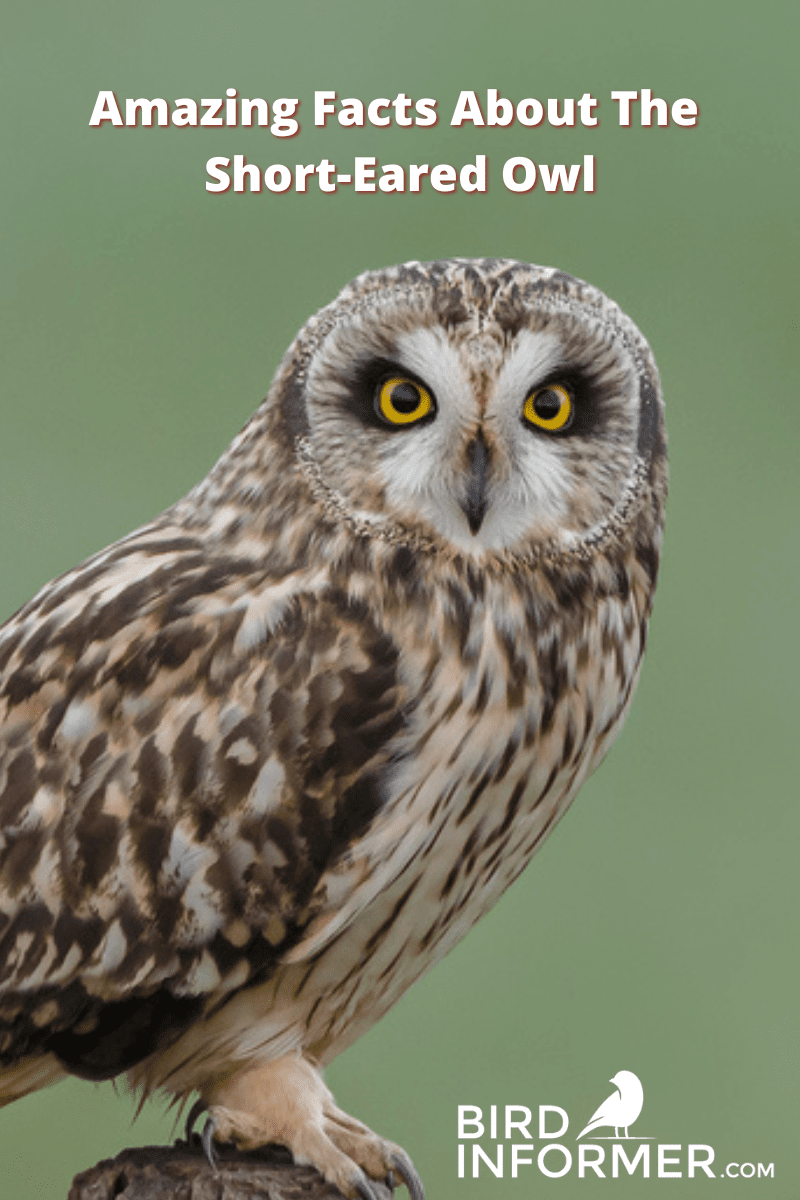
Short-Eared Owl: Bird Identification, Habits, Facts, Nesting

The short-eared owl is a beautiful bird species that goes by a number of other names including prairie owl, marsh owl, and grass owl. Their names are derived from the type of territory that these majestic creatures like to dwell in. They prefer open country, low scrublands, marshes, and grasslands.

The English have given them an entirely different nickname called Shorties. Birdwatchers can rejoice because the short-eared owl is in plentiful supply on five of the seven continents. They don’t have a presence in Australia or Antarctica, but they can be found everywhere else.

Right now, I’d like to tell you much more about the wonderful short-eared owl population in greater detail. I’m going to cover a number of important topics that include the following:

  • How to quickly and easily identify short-eared owls 
  • Important and fun short-eared owl facts
  • Short-eared owl differences between males and females
  • Migratory habits, nesting behaviors, feeding habits, dietary preferences
  • More important short-eared owl facts

To find out much more about these majestic nocturnal creatures, please keep reading below.

Short-Eared Owl Bird Facts

  • Common Name: Short-eared owl
  • Scientific Name: Asio flammeus
  • Scientific Family: Strigidae
  • Life Span: 4-12 years
  • Size: 13.0 to 17.0 inches
  • Wingspan: 33.0 to 43.0 inches
  • Weight: 7.3 to 16.8 oz
  • Conservation status: Least Concern

How To Identify A Short-Eared Owl

The short-eared owl has a medium build, white and buff on the upper parts of its body, and spotted Brown throughout the rest of its body. It has a pale face, and yellow eyes, and its eyes have black outlines going around them.

The breast of the short-eared owl is streaked with heavy streaks of brown. The belly and chest are buffy or pale.

Differences Between Male & Female

The major difference between female and male short-eared owls is that the males have power-looking colors. Otherwise, they look relatively the same and are nearly the same in size.

Differences In Summer Plumage vs Winter Plumage

Short-eared owls appear to maintain the same color plumage during Winter, Spring, Summer, and autumn.

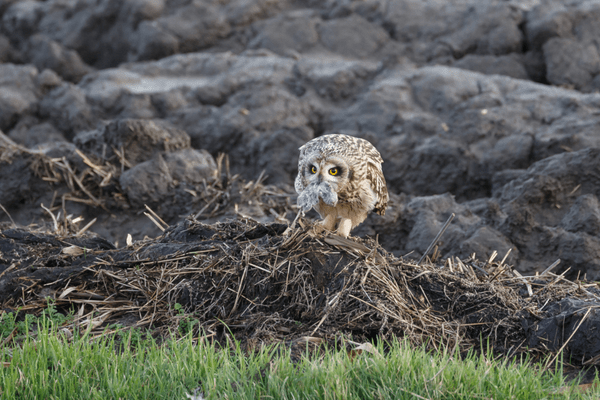
short eared owl in nest on ground

Where You’ll See Short-Eared Owls

For the most part, you’ll find an abundant concentration of short-eared owls when there is an abundant amount of available prey. For the most part, these beautiful owls are found regularly in tundras, dunes, marshes, and prairies. They can also be found in open countries, in particular in areas where there are lots of small rodents available as prey.

Most commonly, you’ll find Shorty or owls nesting in coastal prairies, inland prairies, farmland, marshes, and tundras. During the winter, these birds tend to stick to shrubby areas, coastal dunes, small Meadows, and stubble fields.

As mentioned earlier, short-eared owls live abundantly throughout the United States, Canada, and parts of Mexico. They maintain permanent residences in the northwestern states of the United States and parts of Canada. But they are available in plentiful supply as non-breeding residents throughout the rest of the United States.

Short-Eared Owl Migration Patterns

Unlike many other owls that remain sedentary in their favorite territory, certain short-eared owls living in colder climates are migratory birds. Although, they do not possess a regular migration pattern. These birds are nomadic and migrate irregularly based on the temperature and weather.

For the most part, the majority of short-eared owls in the western part of the Washington lands and valleys are just visiting for the winter. They move into areas that are warmer than other parts of Washington state.

Diet and Feeding Preferences

The short-eared owl diet mainly consists of eating rodents. Voles are usually the prey that’s most prevalent and easy enough to feed on. But they also eat other rodents including pocket mice, deer mice, and lemmings.

Besides rodents, they and other small mammals as well including muskrats, bats, gophers, rabbits, and shrews. And when they live in coastal regions, they will even eat other small birds.

Short-Eared Owl Nesting Facts

  • Clutch Size: 1-11 eggs
  • # of Broods: 1-2 broods
  • Incubation Period: 21-37 days
  • Nestling period: 12-18 days
  • Egg Description: Cream/white

The owl will keep its nest site on dry ground. You can find it on a raised ridge or hummock. This is especially true when they are living in marshes. They like to keep their nest safe and protected under a shrub or hidden within the tall grass. You’ll very rarely find a short-eared owl nest above ground.

 The female Shorty owl builds their nest within the soil in a depression. She will line the nest with feathers and grass to make it cozy and comfy for her and her hatchlings. 

Short-Eared Owl Behavior

  • Active behavior of short-eared owls, unlike many other owls, are actually around and active during the daytime. This makes it a lot easier to spot short-eared owls when compared to other owl species.
  • These owls are mainly active at dusk and dawn. So, if you want to get a glimpse of your favorite short-eared owl, you should look for it during these particular times of the day.
  • During courtship, the male owl will perform courtship flights that are quite dramatic. These courtship flights contain wing clapping and vocalizing in a very loud and noticeable manner. These courtship flights happen during the breeding season.
  • Short-eared owls like to live on open terrain. You’ll find them active during the daylight in marshes and prairies. The owl will fly low over a field while hunting, which is how you’ll know when it’s in the middle of catching its prey.
  • The short-eared owl finds its prey in the daytime by sight and sound.

Tips for Birdwatchers On How To Attract Short-Eared Owls

As a property owner, one of the best ways to attract these owls to your backyard is to let them manage your pests. 

What does that mean? It means that instead of using exterminators or rodenticides, just allow this creature to take care of your potential rodent problems. This will attract many more of these owls to your backyard because they will have a plentiful supply of rodents to capture along with other small mammals that they consume as food.

These owls nest on the ground, so it’s important to be very careful of potential nesting places for these beautiful raptors. When you’re cutting the lawn, make sure to steer clear of potential ground nests because this could damage the nest and potentially harm the owls and their young during nesting season.

There’s no need to hang a nesting box in your backyard to attract these owls. They build their nests on the ground, so a nesting box isn’t going to be very attractive to this particular owl species. It’s a good idea if you’re looking to attract other types of owls that are known to live in your vicinity, but it will not attract the short-eared owl whatsoever.

Leaving an available water source for short-eared owls is always a brilliant idea. They use this water to drink and bathe themselves and their young. It makes it easy for these incredible raptors to remain clean and hydrated with healthy freshwater.

Avoid mowing the lawn too often as well. Small rodents and other mammals like to hide in the long grass. This creates opportunities for short-eared owls to easily catch and consume small rodents, voles, mice, and other smaller creatures.

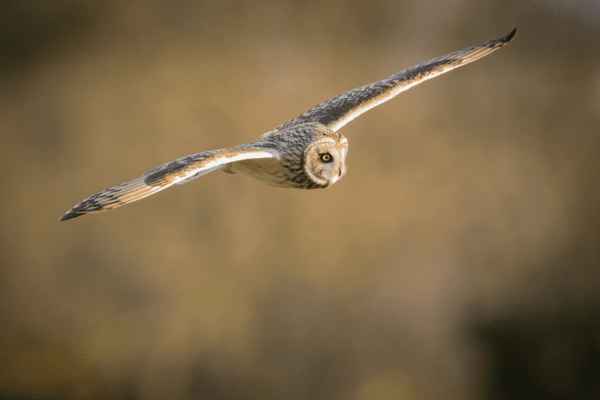
owl in flight

Conservation Status

The short-eared owl is considered to have the Least Concern conservation status in North America. In fact, this owl species is considered one of the most widely distributed throughout the entire world.

Nevertheless, since 1970 in North America, the species has in a regular presence throughout its typical range. Its population has also declined by 65%. The North American range of the short-eared owl covers the majority of Canada and large portions of the northern US.

Fun & Interesting Facts

  • The short-eared owl lives on the Hawaiian Islands. This doesn’t seem like a major accomplishment at first, but it’s actually only one of two owl species that live in Hawaii. It arrived here naturally by traveling to the area from Alaska. The barn owl is the only other owl species living in Hawaii as well.
  • Short-eared owls are known for traveling long distances. While migrating, it’s been documented that they can travel up to as much as 1200 miles. Many of the distances traveled are overwater, which is an amazing feat in itself. On occasion, breeding populations are discovered on remote oceanic islands.
  • Short-eared owls are known for nesting on the ground. Many owls avoid this practice and prefer nesting in shrubs or trees. The female creates the nest via feathers, herb stocks and grass stems that are scraped together.
  • The mail short-eared owl has an elaborate courtship ritual to attract females. The ritual is part of a particular flight that is quite beautiful in nature. The male will clap its wings quite audibly underneath its body. When it claps its wings, it sounds like it’s cracking a whip. These wing claps take place incredibly quickly in fast bursts of 10 claps per second.
  • After being born, the short-eared owl would begin leaving the nest within 14-18 days old. Even though it cannot fly yet, it will spend its days walking or running around on the ground. More than likely, this young short-eared owl will remain close to the nest and continue to receive care and food from its parents.

Explore More Species in This Family


from BirdInformer.com https://ift.tt/YPuUm3X

Boreal Owl: Bird Identification, Habits, Facts, Nesting

The boreal owl has a number of other common names including sparrow owl, Richardson’s owl, Tengmalm’s owl, Arctic saw-whet, and funeral owl.

This small owl doesn’t possess any ear tufts as many other owls do. The female and male members of the species both have very similar plumage. 

Generally, the upper parts of the boreal owl are dark brown. The backside of the owl possesses large white spots. It has a thickly spotted crown with lots of small white spots adorning it. And the owl also has a white facial disk that has dark brown borders going along the sides.

I’d also like to share a number of other important facts about boreal owls. The topics that I’ll cover in greater detail include:

  • Properly identifying boreal owls
  • Fun and interesting facts about them
  • The differences (if any) between female and male boreal owls
  • Behaviors and habits including nesting habits, migratory habits, feeding behaviors, and nesting behaviors
  • Other critical facts about these beautiful hooting creatures of the night

Learn all this and more by continuing to read below.

Boreal Owl Bird Facts

  • Common Name: Boreal Owl
  • Scientific Name: Aegolius funereus
  • Scientific Family: Strigidae
  • Life Span: 12-6 years
  • Size: 8.7 to 10.6 inches
  • Wingspan: 20.0 to 24.0 inches
  • Weight: 4.6 to 6.3 oz
  • Conservation status: Least Concern

How To Identify A Boreal Owl

Boreal owls possess brown feathers over most of their body. They do have white spots that go down their back and they also have a white belly with brown streaks that go down it. They have yellow eyes and a whitish/grayish facial disk that has a brown border. On the crown of their head, you will find tiny white spots.

Differences Between Male & Female

There really aren’t too many differences between male and female boreal owls based on plumage and colors. But the one distinct and noticeable difference is the female boreal owl is much bigger than her male counterpart. 

A male could weigh 4.5 ounces, while a female will weigh 6 ounces. Females also have bigger wingspans and larger bodies as well.

Differences In Summer Plumage vs Winter Plumage

There aren’t any significant differences between winter and summer plumage of the boreal owl.

boreal owl sitting on tree trunk looking at camera

Where You’ll See Boreal Owls

For the most part, you will find boreal owls in deciduous forest habitats. They prefer forests that are filled with a wide array of tall trees including Spruce, Birch, and Pines.

They also like roosting within dense coniferous trees. These trees provide the small owls with protection against inclement weather. It also makes it much harder for predators to find and eventually capture them, which is a boon to their survival.

Boreal Owl Migration Patterns

Boreal owls do not migrate per se. But at times when food becomes scarce due to a lack of potential prey, they will become nomadic and move outside of their typical range or territory.

In North America, you can find boreal owls within the northern reaches in parts of Canada and Alaska. This owl also makes its home in the northern regions of Eurasia.

In the South part of North America, you can find the smallish owls in certain mountain ranges, but in particular the Rocky Mountains in the West. They also make their home in northern Minnesota too.

boreal owl sitting on mossy rock

Diet and Feeding Preferences

As predators, the boreal owl will hunt small prey including insects, birds, and small mammals. In particular, you’ll find that their diet includes squirrels, mice, shrews, and voles quite regularly. They can find and hunt these small creatures easily as they remain low to the ground.

Boreal owls typically hunt at night. The only exception to this rule is when they live in the far north because the sun doesn’t actually set during the summer.

Boreal Owl Nesting Facts

  • Clutch Size: 2-9 eggs
  • # of Broods: 1 brood
  • Incubation Period: 26-32 days
  • Nestling period: 27-36 days
  • Egg Description: Dull white

Unlike many other birds, the boreal owl chooses to forgo building its own nest with sticks and other accumulated materials. As an alternative, the boreal owl likes to occupy the natural tree cavities or woodpecker holes left behind in trees. 

In these tree cavities, the boreal owl will lay its eggs on the substrate that naturally occurs within the woodpecker hole or tree cavity. They aren’t against using man-made structures for their homes either. In fact, boreal owls are known quite well for using nesting boxes frequently, which is a great option to have if you’re attempting to attract them to your backyard.

Boreal Owl Behavior

Boreal owls have certain behavioral characteristics that make this particular bird quite special. These characteristics include:

  • They remain far away from other owls and various creatures of the earth. They are not social creatures and prefer spending time alone. This is true even during the breeding season for the boreal owl.
  • As a nocturnal creature, the boreal owl prefers to live its life during the night. It’s during the nighttime that you’ll find the boreal owl the most active.
  • The boreal owl is a species that prefers to remain in its usual territory, so it isn’t a migratory bird. Although, occasionally when food sources are running dry or the weather gets particularly cold, you may find them moving south during autumn.
  • Cavities carved into trees by woodpeckers are the preferred nests of the boreal owl. They are relatively small in stature, so they have no trouble fitting into these woodpecker-made tree cavities that they respectfully call home.
  • This owl is known as a hunter that prefers to perch on branches that are low to the ground. Once they’ve located their prey, they will simply glide from their perch toward the ground and snatch up their prey within their talons.
boreal owl perched on tree branch

Tips for Birdwatchers On How To Attract Boreal Owls

Attracting these owls to your backyard might be a lot easier than you think. Some of my favorite tips include the following:

  • Install nesting boxes in a secure location in your backyard. Make sure it’s high enough in the tree (20-30 feet) and that the nesting box is off the ground but still close enough to the ground for easy hunting.
  • Avoid pruning the biggest tree branches in your trees. These make excellent perches for boreal owls that they will find very attractive. Leave these large branches to provide ample perching places for your fine feathered friends.
  • Provide these owls with a birdbath. They aren’t the largest owls in the world, so the bath doesn’t need to be gigantic. It can be a relatively small birdbath that the boreal owls will use as a fresh source of water and a place to take a bath.
  • If you have outdoor floodlights in your backyard, please keep them off or take them off of a timer. You do not want these lights going off late at night because it will scare away boreal owls. They do not like having artificial lights turned on in their territory or nesting ground, which would disrupt their nocturnal lifestyle.
  • Mow the lawn in your backyard much less frequently. This creates much better hunting ground for these creatures because they hunt small prey including mice and voles. The long grass gives the small prey the illusion of security, which is great for the silent owl when it swoops down and catches these rodents and small mammals in its talons.

Conservation Status

The conservation status of this creature is Least Concern. This means that conservationists aren’t concerned about the population depletion of this owl. They currently have a large population that doesn’t appear to be dwindling anytime soon.

Fun & Interesting Facts

  • This owl is an incredibly secretive bird. it’s very elusive and it does a great job of remaining well hidden from potential predators. Since it’s such a small owl, it’s preyed upon by other owls and birds including Northern Goshawks, Cooper’s Hawks, Tawny Owls, Great Horned Owls, and other feathered predators.
  • The binomial and genus names of this owl are very interesting indeed. The genus name stands for bad omen and the binomial name stands for the funeral. Basically, the scientific name of boreal owls is Aegolius funereus, which stands for bad omen funeral. One can only assume that their presence led to many deaths in the past.
  • The female boreal owl is known as a hen, while the male boreal owl is known as a cock.
  • Another name for this creature is Richardson’s owl.
  • After the male boreal owl finds a nest during mating, he will call the female owl to let her know about his newest discovery.
  • Male owls of this species are known for their beautiful singing voices. They sing in an effort to attract females. The female owl of this species, on the other hand, makes a relatively aggressive sound and it’s a lot less melodic than her male counterpart.

Explore More Species in This Family

✅ 🦉 #BirdInformer #BorealOwl via @birdinformer" style="display:none"/>

from BirdInformer.com https://ift.tt/ncO3MSA

Long-Eared Owl: Bird Identification, Habits, Facts, Nesting

The long-eared owl, otherwise known as the cat owl or lesser horned owl, is a species of medium-size. As an owl species, it is considered one particular species with an extensive breeding range.

From a scientific standpoint, the actual name of this bird species is A. otus and it’s a member of the Strigidae family. You’ll find this species of owl throughout a wide range of breeding areas. But more specifically, you can find this owl in North America, the Palaearctic, and Europe.

Besides the wonderful facts that I already shared with you today, I’d also like to tell you about many other important long-eared owl-related topics. So, I will take a deep dive into the following areas regarding that include:

  • The easiest way to identify a long-eared owl
  • Long-eared owl fun and interesting facts
  • Long-eared owl physical differences between females and males
  • Behavioral, migratory, feeding, and nesting habits of the long-eared owl
  • Even more crucial facts

Discover all of this and more about the long-eared owl below.

Long-Eared Owl Bird Facts

  • Common Name: Long-Eared Owl
  • Scientific Name: Asio otus
  • Scientific Family: Strigidae
  • Life Span: 10-30 years
  • Size: 14.0 to 16.0 inches
  • Wingspan: 35.4 to 39.4 inches
  • Weight: 7.8 to 15.3 oz
  • Conservation status: Least Concern

How To Identify A Long-Eared Owl

It’s pretty easy to identify a long-eared owl. Their feathers are fairly dark. And they have large ear tufts that are very similar to the great-horned owl. They are black tufts with orange or buff fringes. They also have buff or orange faces with very intricate dark brown or black patterns on the feathers.

Their faces are made up of two vertical white lines that go directly between their eyes. And speaking of eyes, they have beautiful yellow eyes that glow brightly in the dark.

Differences Between Male & Female

The common difference between male and female long-eared owls is relatively common amongst all owls. On average, the females are the larger members of the species.

Females can weigh between 6.3-15.3 ounces. Males, on the other hand, usually weigh between 5.6-11.6 ounces. Females also have larger wingspans and they are generally longer creatures than their male counterparts as well.

Differences In Summer Plumage vs Winter Plumage

There don’t appear to be any major differences between summer and winter plumage for long-eared owls.

long-eared owl with eyes almost closed

Where You’ll See Long-Eared Owls

It’s important to note that long-eared owls are found in Mexico, the United States, Europe, and parts of Asia. They are even found in remote parts of the world including the Azores, the Canary Islands, North Africa, and East Africa.

More commonly, you’ll discover long-eared owls in the Western states during all seasons. But they are also located in the northeast in the New England area all season long.

Long-Eared Owl Migration Patterns

Typically, you’ll find long-eared owls in Mexico, the southeastern portion of the United States, and other areas during the winter. They will withdraw from the northern parts of their breeding range during this time. Why? They are looking for warmer and sunnier climates.

Diet and Feeding Preferences

Mainly, long-eared owls prefer to eat small mammals. They specifically stick to voles and mice. But when food is scarce during a particularly tough winter, they will resort to eating small birds as well.

Long-Eared Owl Nesting Facts

  • Clutch Size: 2-10 eggs
  • # of Broods: 1 brood
  • Incubation Period: 25-30 days
  • Nestling period: 45-70 days
  • Egg Description: White

For the most part, long-eared owls will nest in trees. It’s important to note that these creatures like to nest in man-made nesting boxes or those constructed by different species. On occasion, this owl will build a nest on its own, but it doesn’t happen too often.

After the nest is selected, the female will begin laying her eggs. She will lay as many as 2 up to 10 eggs. This usually happens in two-day intervals.

Long-Eared Owl Behavior

Long-eared owls are nocturnal creatures so they definitely prefer hunting at night most of the time. You will occasionally find them active at or before dusk, and this is especially true when it’s time to feed their young.

While hunting, the long-eared owl is known for flying low to the ground. This makes it easy to locate prey via sight and sound. They will swoop down, grab their prey with sharp talons, and then fly away to a safe spot so they can eat their prey whole.

These beautiful owl creatures are well camouflaged and secretive as well. If you’re having a difficult time finding them in your backyard at night, you should spend time outside in the summer or spring and listen for low and long hoots.

Believe it or not, it’s easier to spot long-eared owls in the wintertime. They tend to roost together in much larger numbers. They likely huddled together to stay warm. But even so, this makes it much easier to spot them because there are more of them in larger groups while roosting together.

Lastly, and I’ve already alluded to this already, the long-eared owl is very social, which is weird for owls in general. They specifically like to roost together in groups, and this happens more often during the winter, but they will even roost together in the spring and summer. 

The majority of their groups are made up of as many as 20 individual long-eared owls. Although, when there are lots of available covers, you could find as many as 100 large long-eared owls roosting together in the same place.

Tips for Birdwatchers On How To Attract Long-Eared Owls

Long-eared owls are more than willing to live in man-made structures inside of your backyard. Generally speaking, you can put it in a nesting box, wicker basket, or some other man-made structure and the long-eared owl would have no problem taking it over. In fact, we know this because they usually do not build their own nests, but instead, take over the nest created by other animals.

Besides adding nesting boxes to your backyard, it’s always important to leave the grass relatively long and the branches of trees unpruned. They like to have hidden places to perch so they can easily catch prey in your backyard. 

Keep the grass long because this will be more attractive to small prey and other animals including insects, voles, mice, rodents, squirrels, and other small creatures. Remember, the long-eared owl was hunting prey and eating its prey whole, which means you have to create the proper environment you can call home.

Adding a water source to your backyard is always a great way to attract many long-eared owls. These animals will certainly appreciate having a large birdbath or fountain in the backyard that they can use to keep themselves clean and hydrated. They’ll also use this water to hydrate their young, and their partners. And they will use this water to help keep everyone clean, refreshed, and healthy.

It’s also important to install the nesting box in the right place. The best area is to have it facing away from the wind. Put it in a south-facing direction that will make it easy for the owls to remain warm from the direct sunshine. And most important of all, make sure the nesting box is stable and secure in the tree. If it moves subtly, by wind or other factors, the owls may not use it because they won’t feel protected from other owls, the wind, or various predators.

Conservation Status

Currently, the long-eared owl is determined to have a conservation status of Least Concern. Although there are plenty of long-eared owls in existence and they aren’t ready to become endangered, their population is currently decreasing. This decrease in population is happening because of land clearing, construction, and other reasons for the loss of habitat.

brown owl staring at camera

Fun & Interesting Facts

  • The male owl has a very loud hoot. At times, it can be heard up to 0.7 miles, or 1 km away.
  • These creatures are known for their precision hunting and silent flight. They have feathers that have downy surfaces and fringed edges, which make them the perfect silent assassins because they have a really muted sound while flying through the air.
  • These owls also have incredible hearing. Their ear openings are placed asymmetrically, plus they have sound-catching facial discs that are very large, which makes it easy for these owls to hear sounds from miles away.
  • When a Long-eared owl catches its prey, it will swallow the entire thing as a whole. Later, it will regurgitate the indigestible parts in the form of pellets. It usually regurgitates these pellets once per day. It’s fascinating to pick through regurgitated long-eared owl pellets because they contain all kinds of fur, small animal bones, and other interesting things.
  • Long-eared owls are prominently populated throughout Eurasia and North America. You can also find them in isolated groups throughout east and north Africa, the Canary Islands, and the Azores. We know a great deal about long-eared owls in Europe and the United States, but we know very little about the ones in other parts of the world.
  • It is well documented that long-eared owls will appropriate nests from other species of birds or other creatures. In one instance, researchers discovered and documented long-eared owls appropriating nests that were previously constructed by American Crows very recently.

Explore More Species in This Family

✅ Click Here To Learn More About This Owl 🦉 #BirdInformer #LongEaredOwl via @birdinformer" style="display:none"/>

from BirdInformer.com https://ift.tt/FlxgaHQ

Friday, August 26, 2022

Western Screech Owl: Bird Identification, Habits, Facts, Nesting

The Western screech owl, also known by the scientific name Megascops kennicottii, is an owl that goes by other monikers. Some other common names for this gorgeous bird include Yuma screech owl, Pasadena screech owl, California screech owl, Kennicott’s screech owl, Guadalupe screech owl, and Vinaceous screech owl.

It isn’t surprising to learn that the name screech owl is taken from their distinctive singing. It’s based on the calls that they make that have a wailing and warbling sound. Their babies are born blind and remain helpless during the first weeks of their lives. These owlets rely on their mom and dad to provide food, shelter, comfort, and warmth.

Right now, I’m going to tell you about a wide range of other critical facts about Western screech owls. I’ll dive deeply into the following topics:

  • How to identify Western screech owls
  • Interesting factoids about Western screech owls
  • Nesting preferences, behavioral habits, migratory preferences, and feeding habits
  • The physical differences between male and female Western screech owls
  • Other important facts

Find out more about these stunning birds by continuing below.

Western Screech Owl Bird Facts

  • Common Name: Western Screech Owl
  • Scientific Name: Megascops kennicottii
  • Scientific Family: Strigidae
  • Life Span: 13-19 years
  • Size: 7.48 to 10.0 inches
  • Wingspan: 6.63 to 6.87 inches
  • Weight: 3.1 to 7.8 oz
  • Conservation status: Least Concern

How To Identify A Western Screech Owl

Western screech owls tend to blend into their surroundings, which makes them birds that are supremely camouflaged. Their overall base colors include a grayish hue, reddish-brown hue, or brownish hue.

Differences Between Male & Female

Male and female Western screech owls look very similar to one another. They are usually mostly gray with dark streaks upon their chest and white bars upon their wings. They also have white streaks on their shoulders.

The females tended to be bigger and weigh more than their male counterparts. Even though this doesn’t completely indicate gender, males often have brighter feathers.

Differences In Summer Plumage vs Winter Plumage

Western screech owls do not change colors or show plumage differences during different seasons.

western screech owl sitting in a tree looking outside

Where You’ll See Western Screech Owls

These small majestic birds tend to make their home in a wide variety of terrain types in the West. You’ll find them in southeastern Alaska in the coastal forests. They also make their homes within the Arizona desert cactus groves. Even more interesting, it’s even possible to find them living in suburban areas.

They prefer living in forested habitats, residential areas and urban parks, backyard nesting boxes, and tree cavities.

Western Screech Owl Migration Patterns

In North America, they make their home in Mexico, and a large portion of Canada, in the southeast they live in Alaska, and they also range throughout Texas from the southern to western borders.

Diet and Feeding Preferences

Western screech owls mostly eat large insects and small mammals. This includes a wide variety of species that live throughout various regions and habitats.

You’ll find these owls preying upon creatures that include pocket gophers, centipedes, voles, spiders, beetles, mice, moths, scorpions, snakes, small birds, fish, frogs, and lizards.

Western Screech Owl Nesting Facts

  • Clutch Size: 2-7 eggs
  • # of Broods: 1 brood
  • Incubation Period: 26-34 days
  • Nestling period: 27-35 days
  • Egg Description: White

Like other owls, the Western screech owl doesn’t personally build its own nest. It will find a cavity or depression – like the hollow of a tree for example – and use it to lay eggs. It will not even bring its own material into the cavity, but instead, it uses whatever is already available.

Western screech owls typically occupy a cavity that’s roughly 1 foot in diameter and only a foot and a half deep. The entrance is large enough to allow the owl’s body to fit in the cavity, but that’s about all.

It’s assumed that Western screech owls prefer small cavities in an effort to keep out larger predators.

Western Screech Owl Behavior

The feeding behavior of the Western screech owl is that it likes to hunt at dusk and it also hunts at night. Typically, this bird will wait and watch for predators to enter its territory. 

It will then swoop down and catch its prey and its talons by lifting it off the ground or picking it up from the foliage. The screech owls in the West also like to catch insects as they are flying through the air. Even more interesting, they hunt predators by sight and sound.

The Western screech owl isn’t afraid to aggressively defend its nest. In fact, if human beings are encroaching upon its nest or territory, this owl will potentially attack. And it will aggressively defend its nest against any and all potential predators.

The Western screech owl is specifically known as a nocturnal creature. During the day, it will spend its time inside of its nest hole or it will roost. On occasion during the day, you can find this owl with its head peeking out of its entrance hole enjoying the sun as it beams down on its face.

This bird is also known as a socially monogamous owl. Screech owls will pair off and remain monogamous with their partner. They will even raise their young owlets together. Although, it’s known that either mail or females will meet outside of their monogamous pairing from time to time.

Preening together is also an important part of the Western screech owl’s self-care routine. The male will preen the female partner and the female will preen the mail and return.

The mating ritual has the male screech owl bringing food to the female during the courtship process. They will also sing duets together, which creates very beautiful music.

While their breeding season is taking place, the male will roost very close to the nest cavity. And as the last few weeks of nesting are happening, the female will suddenly leave the nest but roost very close to her male partner, even touching bodies together.

The adult male and female Western screech owls take their jobs of guarding the entrance to their nest very seriously. They protect the nest vigorously and aggressively from jays, crows, and other potential predators.

During nesting, the male will also provide food to the young owlets and the female. The female will remain with her young owlets for the first three weeks. But as time moves on, she will take breaks from the nest to hunt with her male partner.

Young owlets in the Western screech owl family typically leave the nest before they have gained the ability to fly. They will remain close to their parents for roughly 5 weeks upon leaving the nest.

Tips for Birdwatchers On How To Attract Western Screech Owls

Putting up a nesting box is one of the best ways to attract a pair of male and female Western screech owls. The best time to install the nesting box is far in advance of the breeding season. Breeding season takes place from late April through late May, but the owls will potentially begin occupying nesting boxes by mid-March.

Adding a water source is also another great way to attract Western screech owls and other owls for that matter. Since this version of the screech owl is on the smaller side, the birdbath doesn’t need to be particularly large in this case. But make sure the water source is big enough to provide ample room for the owls to bathe, drink, and luxuriate in the water.

Feeding on prey is always of the utmost importance to Western screech owls or any other bird species for that matter. To create an attractive environment with lots of available prey, it’s best to keep the grass on the longer side. This will attract more mice and other small mammals that the Western screech owls can catch and eat as food.

Having lots of insects and reptiles in your backyard is certainly a great way to attract screech owls and other birds as well. So, make sure your environment is conducive to attracting reptiles and insects when appropriate and this should lead to more Western screech owls nesting in your backyard.

small western screech owl looking off into the distance

Conservation Status

The conservation status of this owl is considered Least Concern. This means that the population isn’t in danger of becoming extinct. In fact, it’s estimated that the overall Western screech owl population consists of 180,000 owls.

Although, the Western screech owl population in the Pacific Northwest has recently become vulnerable. The barred owls arrived in their territory not that long ago due to clearcutting, which has caused a negative impact on the overall number of Western screech owls in existence.

Fun & Interesting Facts

  • Before breeding begins, the male Western screech owl will present food to its female mate. The male also initiates courtship displays of an elaborate nature to impress and attract the female. This consists of a sort of dance of hopping, bill snapping, and bowing.
  • This owl is considered a “sit and wait” predator. This means it will remain perched on its roost while waiting for predators to arrive in its territory. They initiate their foraging activities immediately prior to sunset.
  • The ideal nesting location for these owls consists of man-made nesting boxes or tree cavities. They do not prefer nesting in other potential nests unless absolutely necessary.
  • These creatures will live in a wide variety of habitats. But the most important thing is that wherever they choose to live, it should have plenty of bushes, fruit tree orchards, forests, and deserts. It’s quite possible that a family of Western screech owls will also move into your neighborhood.
  • They do not like to live in the mountains are on hills. They like taking over nests inside the hollows of trees. Occasionally, they will even take over the former nest of a family of woodpeckers.
  • Out of all of the owls in North America, the Western and Eastern screech owls are the smallest in size and stature. They readily puff out their plumage to make themselves look scarier and bigger when larger predators are threatening their home or family.

Explore More Species in This Family

  • White-throated screech owl
  • Bare-shanked screech owl
  • Foothill screech owl
  • Alagoas screech owl
  • Yungas screech owl
  • West Peruvian screech owl
  • Long-tufted screech owl
  • Choco screech owl
  • Balsas screech owl
  • Xingu screech owl
  • Rufescent screech owl
  • Vermiculated screech owl
  • Pacific screech owl
  • Tawny-bellied screech owl
  • Whiskered screech owl
  • Santa Marta screech owl
  • Black-capped screech owl
  • Cinnamon screech owl
  • Middle American screech owl
  • Bearded screech owl
  • Tropical screech owl
  • Koepcke’s screech owl
  • Cloud-Forest screech owl
  • Eastern screech owl
western screech owl PIN

from BirdInformer.com https://ift.tt/QTkgu6d

Spotted Owl: Bird Identification, Habits, Facts, Nesting

Spotted owls are very popular birds although their overall population numbers are beginning to decrease. They aren’t considered in danger of becoming extinct yet, but there is cause for concern.

There are three specific subspecies of spotted owls. There are northern spotted owls, California spotted owls, and Mexican spotted owls. They remain predominantly in North America in places like California, Washington, Oregon, and Mexico. They are also found in British Columbia as well.

Today, I’d like to teach you many important facts about these beautiful creatures. Other names are Hoot Owl, Brown-Eyed Owl, Wood Owl, Canyon Owl, and Pootie Owl.

Right now, I’d like to cover the following topics below:

  • Tips for identifying spotted owls
  • Characteristic differences between female and male spotted owls
  • Spotted owl fun facts and more
  • Different habits and preferences including behavioral, nesting, feeding, and migratory
  • Even more interesting facts

Keep reading below to discover everything that I’ve learned.

Spotted Owl Bird Facts

  • Common Name: Spotted Owl
  • Scientific Name: Strix occidentalis
  • Scientific Family: Strigidae
  • Life Span: 10 years
  • Size: 18.5 to 18.9 inches
  • Wingspan: 39.0 to 42.0 inches
  • Weight: 17.6 to 24.7 oz
  • Conservation status: Near Threatened

How To Identify A Spotted Owl

For the most part, spotted owls have dark-brown feathers with a bit of white mixed into the overall color scheme. And on their belly and chest, they are covered with oval white spots that are relatively large. They also have facial discs with pale marks and dark brown feathers that create an X shape between their eyes.

The facial disk on the Mexican spotted owl is much paler than that of its California or Northern counterpart. Also, the spotted owl has dark eyes, as opposed to other owls that often have orange or yellow eyes.

Differences Between Male & Female

Quite commonly, both male and female spotted owls have a very similar-looking plumage, so their feathers maintain a very similar color scheme. The main difference between male and female spotted owls is the difference between most owls. Typically, the females are larger than the males, and in this case, they weigh roughly 10% to 20% more.

Differences In Summer Plumage vs Winter Plumage

It doesn’t appear that the spotted owls’ plumage will change colors during different seasons. They typically stick to their normal climate and territory, which isn’t conducive to feather color changes.

two spotted owls

Where You’ll See Spotted Owls

Spotted owls are prominently well represented on the Western coast of the United States of America and British Columbia. It’s easy to spot a wide array of northern spotted owls and California spotted owls in states including Washington, Western Oregon, and Northwestern California.

They like living in old-growth forests. In particular, they enjoy forests with plenty of Douglas for trees. These trees take anywhere from 150-200 years to reach full maturity. They also like the steep canyons and oak woodlands of California in the Southwest.

Spotted Owl Migration Patterns

The spotted owl is considered a sedentary bird, so it will remain in the same territory and it does not migrate. On occasion, it will be forced to react to temperature changes or a lack of food, so the owl might move around within its typical territory. But it isn’t going to migrate to another location to move away from a harsh winter or particularly brutal summer.

Diet and Feeding Preferences

These owls aren’t creatures that will eat plant food or birdseed. They are predators that hunt down their natural prey. For the most part, the animals that they focus on eating tend to be rodents and other small to medium-sized mammals.

The California spotted owl and northern spotted owl are particularly fond of dusky-footed woodrats and flying squirrels. Even though both of these animal species are limited in number, they tend to be readily available in the wooded areas that both of these types of spotted owls prefer.

The most common prey for spotted owls includes:

  • Brush rabbits
  • Bats
  • Flying Squirrels
  • Red-backed voles
  • Bushy-tailed woodrats
  • Pocket gophers
  • Red tree voles
  • Snowshoe hares
  • Mice

Spotted Owl Nesting Facts

  • Clutch Size: 1-4 eggs
  • # of Broods: 1 brood
  • Incubation Period: 28-32 days
  • Nestling period: 34-36 days
  • Egg Description: White, pearl gray

This owl’s nesting site is typically chosen by the male. He will choose a nest in a relatively dense part of the old forest because he wants an area that has a thick tree canopy and something that’s well-protected from the open sky.

More than likely, he’ll pick a nest that was left behind by all or other birds of prey. Or maybe he’ll choose a nest previously occupied by a squirrel. Or another possibility is he’ll take over a hollowed-out tree trunk or broken-off treetop.

The female will prepare the nest by scraping it out, creating a shallow depression. It will also remove some of the debris left at the site. As far as adding to the nest goes, the female doesn’t provide much new material. She may only add a few feathers and nothing more.

Typically, the nest of the northern spotted owl is somewhere in the neighborhood of 15-23 inches. They prefer their nests to be relatively small and minimalist.

Spotted Owl Behavior

This owl, and in particular, the northern spotted owl, are patient creatures that like to perch and wait to pounce on their prey at night. According to the National Wildlife Federation, this strategy is called “perch-and-pounce.”

The NWF says, “They sit on tree branches at night, using their keen vision to scan for prey in the dark. When a potential meal is spotted, they silently swoop down and capture the prey with their talons.”

Monogamy is also an important part of their life. When a northern spotted owl finds a mate, it will mate with this bird for life.

Although it isn’t the swiftest creature to take flight, it’s very agile and maneuverable nonetheless. It uses quick wing beats interspersed with gliding flight to get from perch to perch. They typically avoid traveling long distances and they usually steer clear of flying above the canopy of the trees.

They move throughout their territory according to temperature changes. This is likely the signifying reason why they prefer living in old-growth forests with multilayered vegetation because it provides ample safety and protection.

These owls remain solitary creatures for most of their lives. The only exception is when they’re interacting with their young or their mate. A pair of mates will typically interact and roost together for 4-6 weeks prior to eggs being laid. And when these owls are roosting together, they will typically preen each other and themselves at the same time.

taking flight in the woods

Tips for Birdwatchers On How To Attract Spotted Owls

These are predators, so their habitat needs to be conducive to catching prey. It also needs to provide adequate shelter and nesting opportunities. Many owls like this prefer to nest inside a mistletoe tangle, the hollow of a tree trunk, or they’ll take over the old nest left by a bird of prey or squirrel.

Attracting these owls doesn’t need to be difficult as long as you have the right type of land. Make sure your land has open skies and trees that spotted owls would like to nest in. The tree doesn’t necessarily have to have a hollow because you can add a nesting box, which the owl will gladly take over because they do not mind living in man-made structures.

Try not to cut the grass too short because these owls are predators and they hunt for small prey. Longer grass means more small predators will be roaming around your backyard including moles, voles, shrews, squirrels, mice, rats, and other rodents.

Installing a large birdbath in your backyard is also a great idea. These birds and other owls for that matter love having a freshwater source available in their territory. In fact, it’s of the utmost importance to their survival. Not only will they use it to drink the water, but they will also bathe in this water and use it to care for their young ones as well.

Conservation Status

This owl’s conservation status is currently listed as Near Threatened. According to the Endangered Species Act, the northern spotted owl, California spotted owl, and Mexican spotted owl are all in the midst of a population decrease. The current number of northern spotted owls is 15,000, but this amount is decreasing year after year.

Why is this happening? One of the big problems is that they are experiencing degradation and loss of habitat. Forests and wooded areas are disappearing all throughout North America, which is definitely posing a major problem. The barred owl is also in competition with the spotted owl for territory. Unfortunately, the spotted owl appears to be losing territory to the barred owl, which is also a major reason for the ongoing population decline.

Right now, the number of northern spotted owls is declining at a rate of 2.9% each year. Logging on private lands, barred owl competition leading to less breeding success, and other aggressive species in the West are other chief reasons why their population is declining.

spotted owl sitting in the tree

Fun & Interesting Facts

  • This owl’s call consists of a series of notes that are four spaces apart and the two notes in the middle remain closest together. It sounds something like “hup, hoo-hoo, hoo.”
  • Although this creature lives for about 10 years on average, it can live up to 17 years old in some cases.
  • In Canada, northern spotted owls are considered endangered species. The same owl is only considered threatened in the US.
  • At two years old, they will reach their sexual maturity. At this time, it will pair off with another spotted owl of the opposite sex and become monogamous for life.
  • The survival of the northern spotted owl is negatively impacted by barred owls. They are taking over the territory of the spotted owls, which makes it difficult for them to survive.
  • They are capable of capturing their prey in midair. Or they can swoop down and pluck their prey directly from branches. They use their bills to break the necks of their prey.
  • When these owls first hatch, their eyes remain closed, they are covered in white down, and they are helpless so their parents must protect them.

Explore More Species in This Family

spotted owl PIN

from BirdInformer.com https://ift.tt/ab6YSo5